Kitty Hawk North Quick Links
Kitty Hawk Wind will help meet the ambitious Virginia Clean Economy Act, which mandates the procurement of 5.2 GW of offshore wind by 2034, while catalyzing the offshore wind industry in the Commonwealth and bringing substantial and direct benefits to the City of Virginia Beach and Hampton Roads region.
Kitty Hawk Wind is designed to deliver clean, reliable electricity to Virginia’s robust electrical grid. Avangrid projects Kitty Hawk Wind will deliver approximately 3,500 megawatts (MW) of clean electricity generation, enough to power roughly 1 million homes and businesses. The project will power Virginia’s economy with clean energy while catalyzing $2 billion in economic development in the next decade, as well as an additional $100 million in tax revenues over ten years, 1 including an anticipated $58 million in property tax revenues paid directly to the City of Virginia Beach. Kitty Hawk Wind will create an average of 800 jobs annually in the Hampton Roads region during construction, and the project will support an annual average of 900 jobs throughout the operational phase of the entire lease area.
The project will bring clean energy ashore from the lease area delineated by the federal government using buried subsea export cables commonly used worldwide to transmit power. The project’s major federal permit application, called a Construction and Operations Plan, requests approval to land subsea export cables in the Virginia Beach Municipal Parking Lot, located in Sandbridge south of the market, as the preferred landfall location for Kitty Hawk North (2 cables) and Kitty Hawk South (4 cables). Kitty Hawk Wind began its work with Virginia Beach and has been in continuous contact with local and state officials and the community since 2019.
Avangrid understands the importance of working collaboratively with local communities and extends our commitment to being open and informative about the project and addressing questions with solid information, engineering analysis, and scientific data. The project is subject to a multi-year state and federal permitting process with multiple opportunities for public comment, including a full Environmental Impact Statement prepared by the Bureau of Ocean Energy Management (BOEM) to ensure the project is developed responsibly.
The onshore construction for Kitty Hawk Wind is like any other utility construction project, such as a road expansion or a sewer installation. While utility projects often cause brief disruptions to the local community, once construction is complete, temporary disruption ceases. Additionally, this project will pose no health or safety issues while delivering significant clean energy and long-term economic benefits to Virginia.
Proposed Route Map
Kitty Hawk Wind proposes development of utility infrastructure necessary to deliver approximately 3,500 MW of renewable offshore wind power to Virginia’s robust electric grid. Components of the project located within Virginia Beach include:
- Installation of six subsea cables buried beneath the seabed along an approximately 36-mile route to landfall (proposed at the Virginia Beach Municipal Parking Lot located in Sandbridge south of the market).
- The underground onshore export cable may be up to approximately 7 miles buried within or adjacent to existing roadways for the majority of the route to the onshore proposed substation.
- An onshore substation proposed on an approximately 36-acre parcel within Corporate Landing Business Park.
Frequently Asked Questions
As a responsible developer, it is Avangrid's objective to avoid undisturbed and protected areas to target strong points in the regional electrical transmission grid to connect the power generated within the lease area delineated by the federal government. The preferred landfall location at the Virginia Beach Municipal Parking Lot, located in Sandbridge south of the market, was selected based on technical, environmental, and regulatory constraints as well as input received from the City of Virginia Beach. This location:
- Avoids impacting military operations and Department of Defense assets at Dam Neck north of Sandbridge
- Avoids conservation areas including Back Bay National Wildlife Refuge, False Cape State Park, and Sandbridge Beach Nourishment Sand Resource Areas
- Utilizes an existing disturbed area (municipal parking lot)
- Provides the shortest direct transmission route utilizing existing rights-of-way to Corporate Landing, minimizing the potential for disturbance to the local community
- Meets the requirement of approximately 2 acres of land adjacent to shore
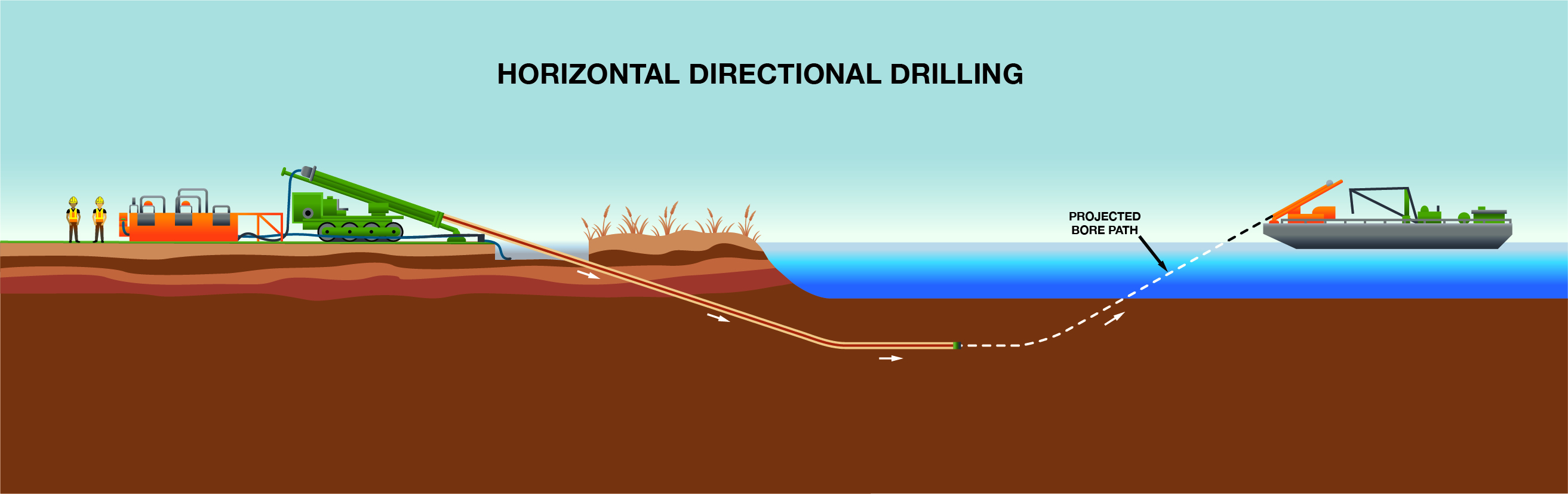
The subsea export cables will be installed using a common trenchless technique called Horizontal Directional Drilling (HDD) to connect with onshore export cables. HDD technology allows for cables to be placed in conduits that will be drilled up to 85 feet under the beach. HDD construction avoids any impacts to the beach or dunes and will being the subsea cables to transition joint bays buried up to 9 feet deep that will allow the subsea cables to be spliced to onshore cables to carry renewable energy to the proposed substation site.
Once construction is complete, there will be no aboveground infrastructure in the municipal parking lot.
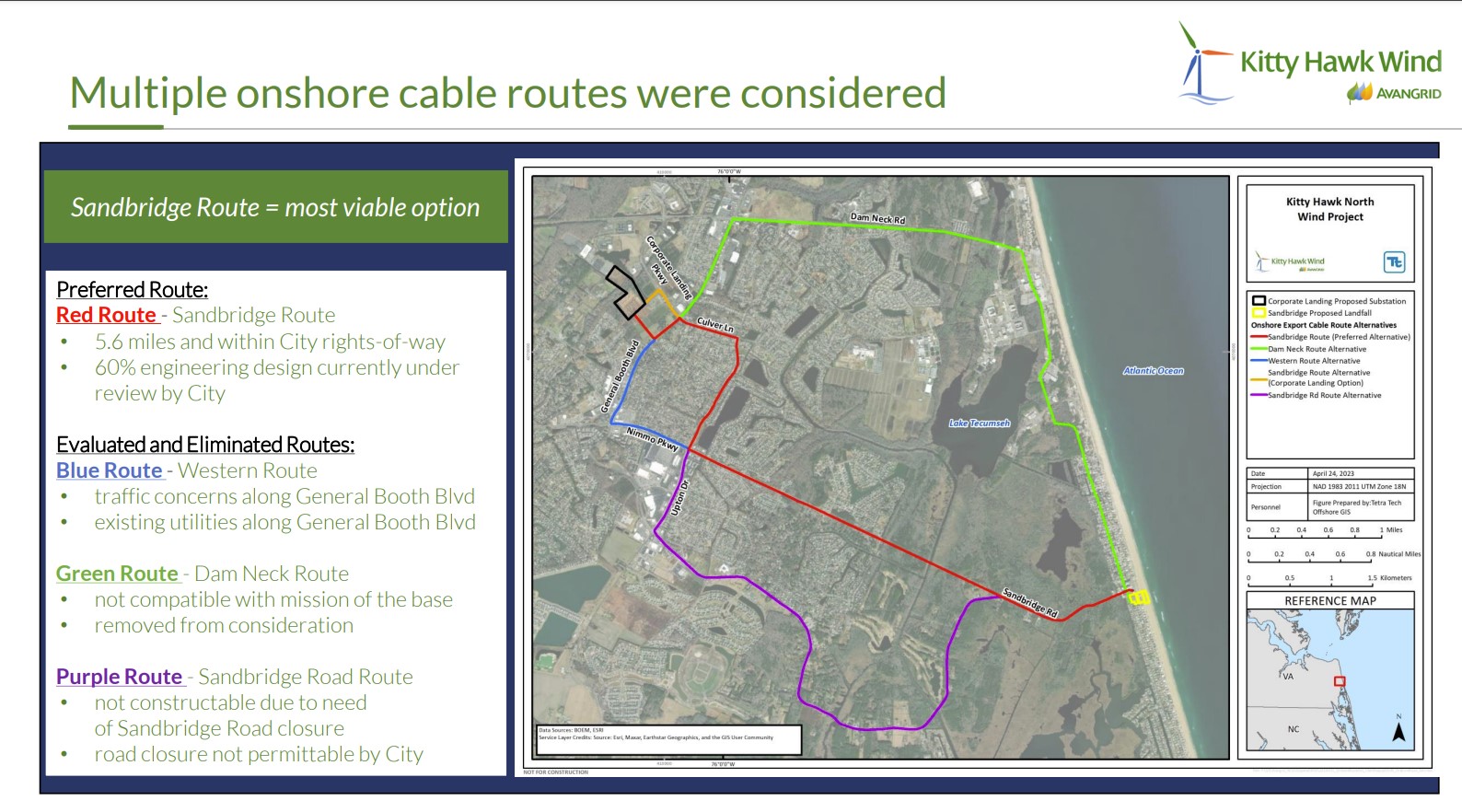
The optimal and most direct transmission route to the point of interconnection into the PJM electric grid at Corporate Landing Business Park in Virginia Beach is approximately 5.6 miles underground along previously disturbed rights of way owned entirely by the City of Virginia Beach (see red route below). For the majority of the route, cables will be co-located with the City’s utilities either in or adjacent to existing roadways.
The project team evaluated and eliminated several route alternatives shown in the map below in consultation with City Engineers and the Department of Defense for the underground export cable corridor.
The cable corridor will not be final until after review and approval by the Virginia State Corporation Commission and the Bureau of Ocean Energy Management.
Avangrid understands that the landfall in Sandbridge, like any utility construction project, will have temporary impacts to residents and visitors going to the area.
To help reduce disruptions, Avangrid is committing to construction of duct banks along Sandbridge Road, transition joint bays in the municipal parking lot, and HDD bores for both Kitty Hawk North and Kitty Hawk South Projects in accordance with the City of Virginia Beach Resort Ordinance’s timeframe of October 1 to May 15.
Businesses and the beach will remain open. Access to the Virginia Beach Municipal Parking Lot south of the market will be restricted.
During construction, Kitty Hawk Wind will use best management practices and implement mitigation measures that will be least disruptive to the community and environment.
Once construction is complete, all that will be visible at the landfall area is a parking lot surface restored to better than current conditions with manhole covers placed flush with the ground for access to the transition joint bays. Cables will come ashore using Horizontal Directional Drilling, burying the cables up to 85 feet under the beach and dunes connecting to transition joint bays. When construction in the Virginia Beach Municipal Parking Lot located in Sandbridge south of the market is complete, there will be no aboveground infrastructure.
Construction will begin no earlier than 2026.
To help reduce disruptions, Avangrid is committing to construction of duct banks along Sandbridge Road, transition joint bays in the Virginia Beach Municipal Parking Lot, and horizontal directional drill bores for both Kitty Hawk North and Kitty Hawk South Projects in one off season, which under the Virginia Beach Resort Ordinance is from October 1 to May 15.
The proposed route would be located on City-owned property. This City-owned property that is being proposed for the cable is abutted to the north and south by the Back Bay Refuge. The cable will not be placed on Back Bay Refuge property.
The onshore cable installation is designed to have minimal impact on the natural environment by using Horizontal Directional Drilling (HDD) technology to place the cables under Asheville Bridge Creek and its associated wetlands in locations where an existing roadway is not present. The preferred route has the least impact to the environment.
The City of Virginia Beach will receive property tax payments for the Kitty Hawk substation and infrastructure in the roadways in addition to payments during the installation of cables as part of the easement with the City at the project landfall. Once construction begins, we estimate Kitty Hawk Wind will generate approximately $58 million in total property tax revenue paid directly to the City of Virginia Beach.
The City of Virginia Beach Development Authority (VBDA) has received payments for the option agreements for proposed substation land parcels at Corporate Landing and Landstown.
Kitty Hawk Wind will also work with the City on potential future projects that will directly benefit residents once construction is complete.
The Project will in no way impede sand renourishment projects. The project’s offshore export cable corridor is sited outside of sand renourishment borrow areas offshore.
Additionally, the geophysical data collected by Avangrid as part of our survey of the area has also identified other potential sand borrow areas that may be suitable for nourishment activities after the existing area has been exhausted.
No. There are no electric fields from underground cables, and magnetic fields are very low at ground level, posing no health risk. Due to the fact that the cables are buried, the magnetic field or “MF” at ground level is very low - a small fraction of what occurs from overhead power lines, and a small fraction of the earth’s natural magnetic field. Magnetic fields are different from radio fields or “RF” given off by cell phones, microwaves, etc. Levels of magnetic fields are comparable to those emitted from typical household appliances such as hair dryers or refrigerators. A report by Virginia Wesleyan University also concludes, “Peak EMF levels at the sites investigated fall within the typical values of household exposure, and are well below the threshold values reported for many common household appliances. The literature surveyed indicates no negative EMF impact on human health.”
Independent verification of professional research and analysis in the Kitty Hawk Wind Construction and Operation Plan (COP) is conducted as part of the federal review process, which includes a full Environmental Impact Statement (EIS) and a certification and verification agent that works on behalf of the federal government. The Bureau of Ocean Energy Management is currently preparing the EIS for Kitty Hawk North, and will prepare an EIS for Kitty Hawk South.
Additionally, for the purposes of having an independent third-party assess the reports completed by Avangrid (and its consultants) for the project in advance of the federal review process, the Virginia Beach Department of Economic Development commissioned and paid for a report by Virginia Wesleyan University titled, "An Assessment of The Impact of the Kitty Hawk Wind Project on the Sandbridge Area.” This report concludes:
- “In conclusion, we find no evidence for negative environmental effects of the proposed wind projects due to EMF generation or Directional Drilling. The data reported by TetraTech and Avangrid appear to be reasonable and conservative, and in line with the values reported in the available scientific literature.”
- “Peak EMF levels at the sites investigated fall within the typical values of household exposure, and are well below the threshold values reported for many common household appliances. The literature surveyed indicates no negative EMF impact on human health.”
- “Directional Drilling is clearly the best way to minimize environmental impacts and precisely position underground utility lines where they will have no negative effects.”
Yes. Kitty Hawk works with the City of Virginia Beach and its traffic engineers as well as the Police Department to create a comprehensive traffic plan to minimize disruptions during construction.
Contact Us