Project Overview
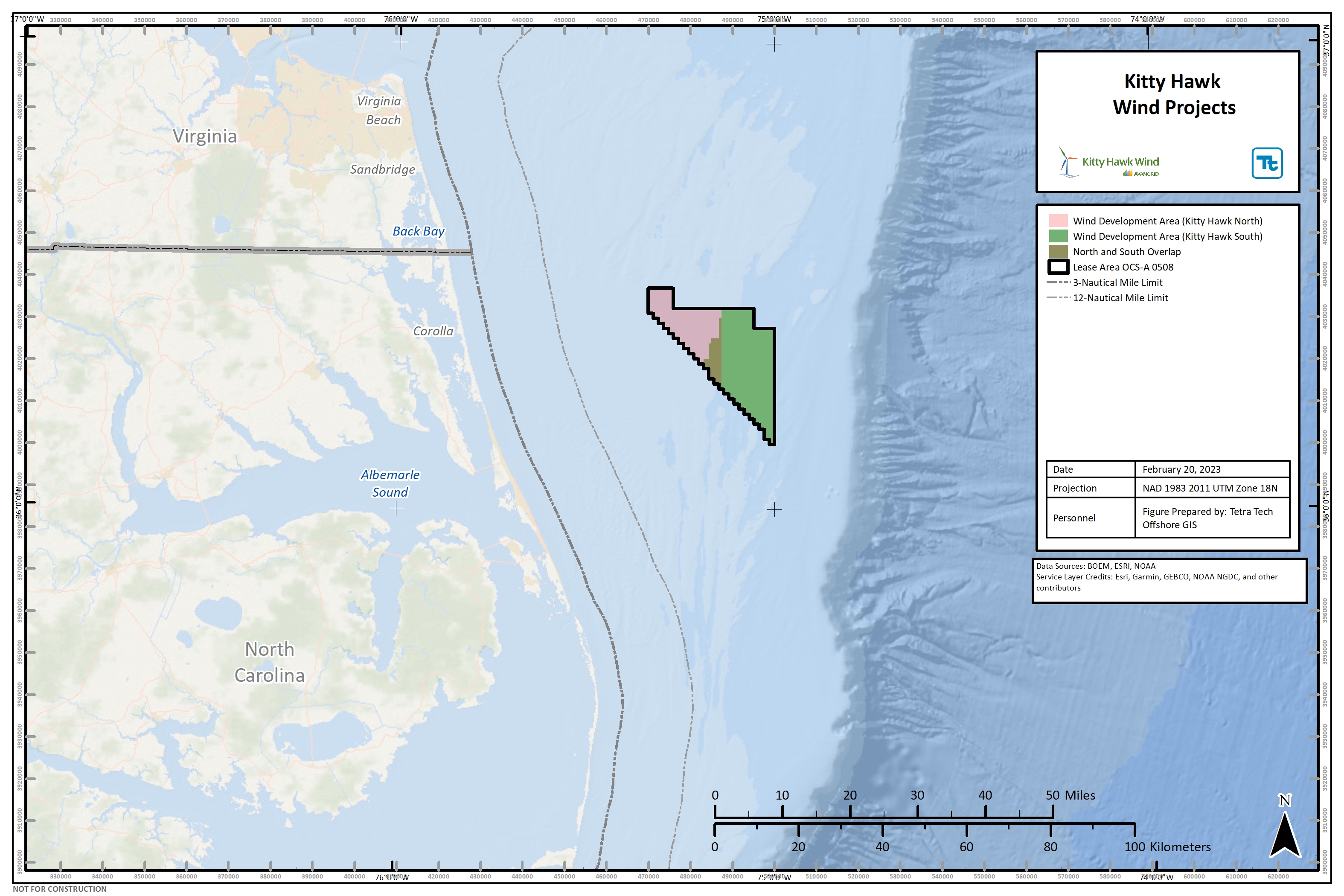
Location
36 miles from Virginia Beach, VA
27 miles from Corolla, NC
Lease Area
122,405 acres
Wind Energy Area (WEA)
~200 square miles
Capacity
~3,500 megawatts (MW)
Site Characteristics
Wind speed: 8-9m/s
Water depth: 30 to 50 meters
(98 to 164 feet)
Project Phases
Kitty Hawk North
1.4 GW ~ 40% of the lease
Kitty Hawk South
2.1 GW ~ 60% of the lease
Responsible Siting
The site was defined through careful planning and review by the U.S. Bureau of Ocean Energy Management (BOEM) and the project developer, Avangrid, including extensive environmental studies and public engagement processes.
Through a competitive auction conducted by the U.S. Bureau of Ocean Energy Management (BOEM) in 2017, Kitty Hawk Wind, LLC, a subsidiary of Avangrid, secured an offshore lease area to develop the Kitty Hawk Wind project.
BOEM delineated this lease area after a four-year evaluation process (2011-2015), involving multiple federal and state agencies, while accepting public comment. This process included review of fish habitat and fisheries conflict areas, military use and commercial shipping routes, environmental review including avian and bat data, benthic habitat, proximity to National Park Service property, and more. BOEM concluded the environmental assessment with a Finding of No Significant Impact from this issuance of the lease in 2015.
The 200 square mile Wind Energy Area (WEA) was selected to minimize impacts to other users of the ocean (such as the military, commercial and recreational fishing, and shipping industries) as well as to minimize impacts to the marine environment and coastal communities. Avangrid began studying the WEA in detail after acquiring the lease in 2017. Study of the area is ongoing as part of the federal permitting process to further refine the design, construction, and operation of the offshore wind project.
Kitty Hawk Wind is designed to deliver clean, reliable electricity to Virginia’s robust electrical grid. The project’s major federal permit application, called a Construction and Operations Plan (COP), requests approval to make landfall in Virginia (Kitty Hawk North and South) as the preferred point of interconnection as well as in North Carolina (Kitty Hawk South) to evaluate reasonable alternatives as required by federal law.
The Wind Energy Area is projected to be able to support 3,500 MW of electricity generation, which would be enough to power approximately 1 million homes and businesses. In the next decade, this clean energy project will generate $2 billion in economic activity, jump-start a new industry, create an annual average of 800 jobs, produce an additional $100 million in tax revenue, and accelerate Virginia and North Carolina’s clean energy transition.
Timeline

Planning & Analysis
The federal stakeholder planning and analysis phase focused on the identification and assessment of offshore areas that could be viable candidates for wind energy – Wind Energy Areas (WEAs). This process included nominations for particular areas, Environmental Assessments for specific activities related to this phase and public input.
DEC 12, 2012
BOEM Publishes Call for Information and Nominations
Learn MoreMar 7, 2013
BOEM Call for Information and Nominations Closes
Aug 11, 2014
BOEM Identifies Wind Energy Areas (WEAs)
Learn MoreJan 23, 2015
BOEM publishes Notice of Availability (NOA) of Draft Environmental Assessment (EA)
Learn MoreSep 18, 2015
BOEM Publishes Notice of Availability (NOA) for Revised Environmental Assessment and Finding of No Significant Impact (FONSI)
Learn MoreLeasing
In this phase, BOEM conducts a process to identify prospective bidders to lease an area offshore North Carolina for commercial wind energy development. BOEM manages an online auction process which results in a preliminary lease agreement for the highest bidder. The preliminary term for the lease is 12 months in which the lease must submit a Site Assessment Plan (SAP) to BOEM.
Aug 16, 2016
BOEM Releases the Atlantic Wind Lease Sale 7 Proposed Sale Notice (PSN) and Request for Interest (RFI)
Learn MoreJan 18, 2017
BOEM publishes Final Sale Notice (FSN)
Learn MoreMar 16, 2017
BOEM Holds Lease Auction
Learn MoreMar 17, 2017
Kitty Hawk Wind, LLC wins Lease Auction
Learn MoreMar 17, 2017
BOEM and Avangrid sign Commercial Lease for Renewable Energy Development
Learn MoreSite Assessment
Following the establishment of a lease agreement, a Site Assessment Plan must be submitted to and approved by BOEM. The SAP describes the metoceanic data collection devices and methods to support site assessment activities. The data collection devices will monitor the wind resource and metocean conditions in support of the Project. Data collection will include the evaluation of: shallow hazards and geological conditions (including seabed constraints such as boulders and debris); marine archaeological resources; and benthic resources. Upon approval of the SAP, the lessee will have up to 4 ½ years in which to submit a Construction and Operations Plan (COP) to BOEM.
Sep 18, 2019
Avangrid Submits Site Assessment Plan (SAP)
Learn MoreApr 8, 2020
BOEM Approves SAP
Learn MoreJun 7, 2020
MetBuoy #1 Deployment
Learn MoreDec 11, 2020
Submit Kitty Hawk North Construction and Operations Plan (COP)
Learn MoreDecember 2021
MetBuoy #2 Deployment
Learn MoreConstruction & Operation
The focus of the Construction and Operations Phase is conducting the Environmental Impact Statement, receiving public input, and gaining approval on the Construction and Operations Plan. Following final approval of the plan construction and operations will begin.
Visit the Permitting Dashboard for Kitty Hawk North & Kitty Hawk South.
Jul 30, 2021
BOEM Publishes NOI to prepare Kitty Hawk North Environmental Impact Statement (EIS)
Learn MoreApril 14, 2022
Submit Kitty Hawk South Construction and Operations Plan (COP)
Learn MoreApril 2024
BOEM Publishes Kitty Hawk North Draft EIS followed by public comment period and public meetings
December 2024
BOEM Publishes Kitty Hawk North Final EIS
2025
Avangrid Submits Kitty Hawk North Design and Installation Plans
2025
BOEM Publishes Kitty Hawk South NOI to prepare an Environmental Impact Statement (EIS)
Summer 2025
All Kitty Hawk North State & Federal Permits In-Hand
2026
Kitty Hawk North Construction Anticipated
2026
BOEM Publishes Kitty Hawk North Record of Decision
2027
BOEM Publishes Kitty Hawk South Draft EIS followed by Public Comment Period & Public Meetings
2027
BOEM Publishes Kitty Hawk South Final EIS
2028
BOEM Publishes Kitty Hawk South Record of Decision
2028
All State and Federal Permits In-hand
2030 - 2032
Kitty Hawk South Construction Anticipated
2050+
Commercial Operation


